MMM: Overview
Introduction
Naukr AI MMM is a Bayesian, panel-aware system for estimating how media and non-media business drivers contribute to an observed business outcome over time. A model can use a national time series or a time-by-geography panel and can represent media at any resolved node level, such as channel, vehicle, campaign, or creative, provided the ingestion layer maps those nodes to parent pooling groups.
The model addresses four related questions:
- How much of the outcome is attributable to baseline demand, controls, and media?
- How does media effectiveness change after carryover and diminishing returns?
- What is the posterior uncertainty around contribution and ROI?
- Is the attribution supported by the data, sampler diagnostics, holdout performance, and prior-sensitivity checks?
The core modeling philosophy is:
- represent the temporal memory and nonlinear response of media explicitly;
- preserve business meaning through outcome-specific conversion and ROI logic;
- use partial pooling when individual media nodes or geographies are weakly identified;
- propagate uncertainty through parameters, predictions, contributions, and ROI;
- select discrete model families outside NUTS using leakage-safe validation;
- separate model estimation from the decision to publish production outputs.
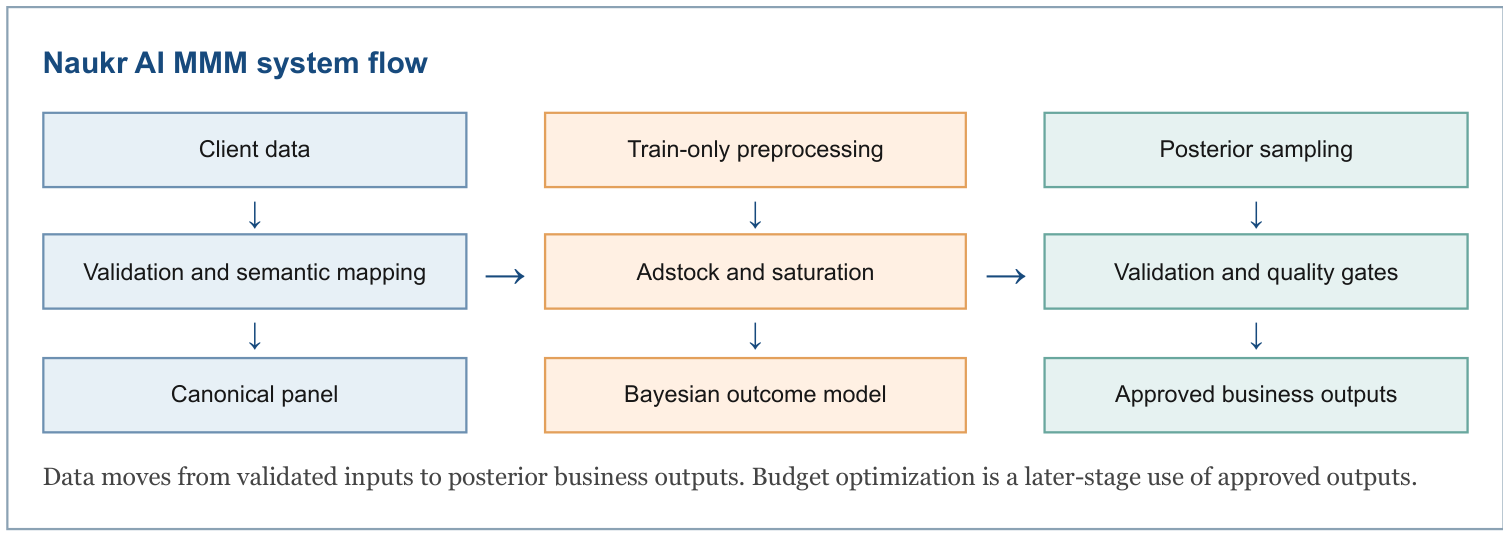
Model architecture at a glance
Client data
  -> schema and semantic validation
  -> canonical time x geography panel
  -> train-only scaling and feature preparation
  -> adstock/carryover by media node
  -> saturation by media node or parent group
  -> optional constrained neural response correction
  -> additive or multiplicative Bayesian outcome model
  -> NumPyro NUTS posterior sampling
  -> posterior prediction and counterfactual reconstruction
  -> contribution, ROI, response-curve, and diagnostic artifacts
  -> quality decision
  -> optional approved all-history production refit
  -> later-stage budget optimization
At a high level, the expected outcome contains:
- a baseline: global intercept, geography offsets, trend, and optional baseline dynamics and seasonality;
- controls: standardized non-media variables with estimated coefficients;
- media effects: scaled exposure passed through adstock, saturation, and an optional shape-constrained neural correction;
- observation noise: Student-t for the additive form or LogNormal, optionally contaminated, for the multiplicative form.
Current capability boundary
| Capability | Current implementation |
|---|---|
| Additive model | Supported and the default |
| Multiplicative log-link model | Supported when the outcome is strictly positive |
| Geometric adstock | Supported |
| Weibull adstock | Supported |
| Weibull-CDF saturation | Supported and the default |
| Anchored logistic saturation | Supported |
| Constrained neural response correction | Supported and configurable |
| Geography random intercepts | Supported |
| Media node to parent-group pooling | Supported |
| Weibull response-curve export | Supported |
| Budget optimization | Included as a later-stage workflow after approved model outputs |
Related documentation
- Models — notation, baseline, adstock, saturation, neural layer, additive vs multiplicative form (
mmm-models) - Workflow — the 15-step end-to-end model flow (
mmm-workflow) - Methodology — priors, NUTS inference, likelihood, diagnostics, identifiability (
mmm-methodology) - Results — posterior contributions, ROI, and uncertainty summaries (
mmm-results)